

South Korea vs Japan. Distinctive cultural identity, tradition and modernity.

Last places for spring travel to Japan, departing 21 May
Japan’s main attractions come together on a trip led by our guide Asaki, a Japanese woman with a Mediterranean soul. She will show us Japan through Japanese eyes, explaining its culture from a perspective familiar to Spanish travellers. Photographer Ariadna Arnés also joins us, inviting us to view the country through a photographic lens.
Japan vs South Korea
Food and drink
The main difference between Japanese and South Korean food is the use of spices. Korean cuisine uses many spices, while Japanese cooking keeps flavours more natural, with few additions. Korean cuisine is especially known for hot, spicy dishes.
Fish and seafood are part of the traditional Japanese diet, with sushi and sashimi among its signature dishes. Koreans eat plenty of rice, vegetables and meat, accompanied by a wide variety of side dishes, including kimchi.
Religion
Japan's predominant religion is Shinto, which coexists with Buddhism and Christianity, although much of the population identifies as non-religious.
South Korea differs in that Christianity and Buddhism play a more prominent role in people’s lives, although, like the Japanese, most South Koreans describe themselves as non-religious.

Writing and Alphabet
Writing reveals a major difference between the languages: Japanese uses 3 different writing systems, while Korean uses one, known as Hangul.
There are several writing systems in Japanese culture, where we can highlight that:
- The Japanese government has registered 2000 kanji, taught at school, with which 99% of newspaper articles can be read.
- Hiragana has 50 characters.
- The 50 katakana characters are a kind of phonetic alphabet (a, i, ou, è, or, ka, ki, kou...).
- Rōmaji is Japanese written in Roman letters
In Korean Hangul, each syllable block uses some of its 24 phonemes: 14 consonants and 10 vowels.

Typical dress
Kimono
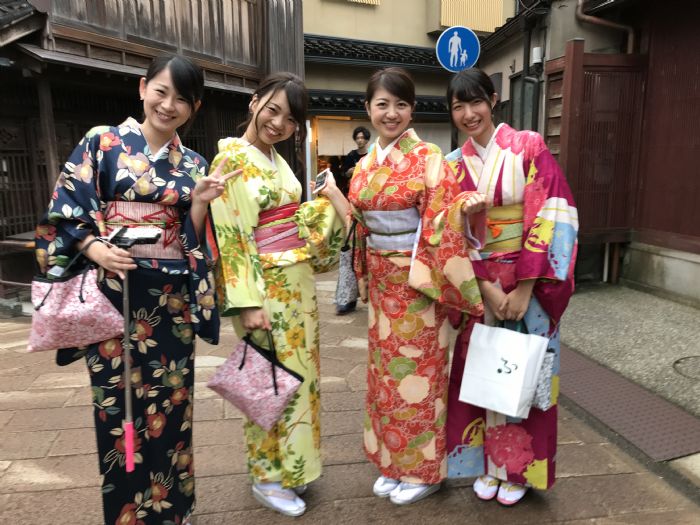
The kimono appeared in Japan in the 7th century, when the Japanese were under Chinese influence. This colourful, ornate garment has evolved over the centuries, particularly through Western influence and the opening up of Japanese society.
The kimono features traditional decoration inspired by nature, including flowers, plants and animals. Its different elements combine to form one of Japan’s most distinctive garments.
Hanbok
Literally meaning “Korean clothing”, it refers to the Joseon period and is worn as semi-formal or formal dress during festivals. Although it dates back to the late 12th century, researchers suggest it may have Mongolian or Siberian origins.
Hanbok colours once distinguished ordinary people from royalty and married women from unmarried women. Although Western influence has reduced its everyday use in South Korea, it can still be seen at traditional celebrations and festivals.

Music
Both countries have moved from traditional musical forms to modern songs with catchy rhythms that have gained audiences abroad. Korean K-pop has become popular in the West. Its Japanese counterpart, J-pop, has a smaller Western following but is Japan's most widely consumed musical genre.
Japan vs. South Korea. Major cities
Cities of Japan
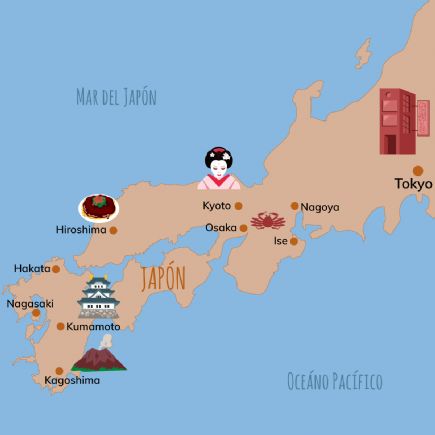
Osaka: Nightlife and food define this city, famed for entertainment and restaurants. Dotonbori is the best area to experience them: a shopping street packed with food stalls open late into the night, serving dishes such as okonomiyaki, gyoza and takoyaki.
Kyoto: For more than a thousand years, it was the country’s capital. Today it is steeped in art, religion and culture, famous for its numerous Buddhist temples, gardens, shrines and traditional wooden houses, as well as kaiseki cuisine and geishas.
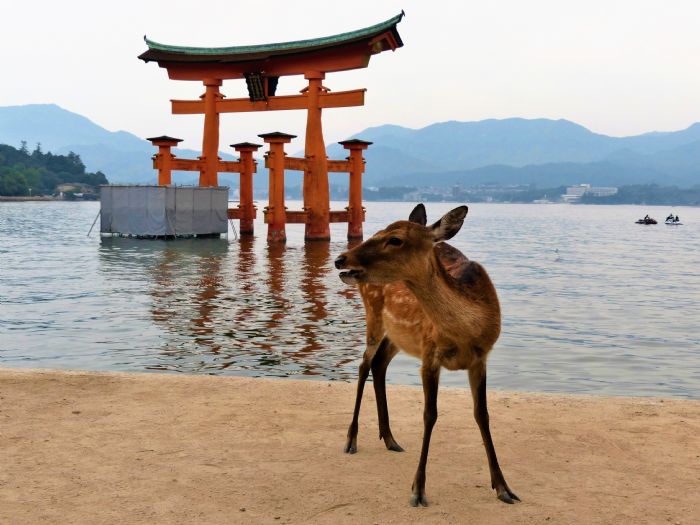
Hiroshima: Sadly known for its tragic history in the Second World War, this city on Honshu offers far more than a reminder of the conflict. Its wooded mountains, crystal-clear waters, shrines and museums are among its main attractions. Nearby Miyajima, with its floating shrine and distinctive torii gate, offers a chance to relax while admiring Japanese tradition.
Kanazawa: It was one of the centres of Japanese culture and art, with museums and workshops on every subject. Must-sees include Kenrokuen Garden, the Higashi Chaya district and Kanazawa Castle in the city centre.
Nagoya: Known as the cradle of samurai warriors, Nagoya is a vibrant city where you can enjoy beautiful cherry blossom at the end of March.
Cities of South Korea

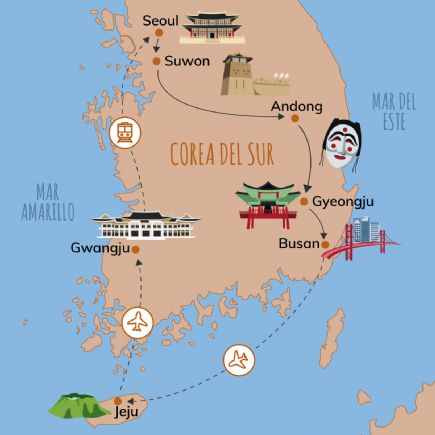
Andong: Ancient Korea’s main trading centre, the birthplace of Confucianism and mask dancing in the country. Here we can step back in time among the hanok streets, enjoy nature and discover local crafts.
Gyeongju: Designated by UNESCO as one of the world’s ten most historic places, it is known as the “museum without walls”. The Tomb Park, home to the 23 tombs of the rulers of the Silla Kingdom, is one of its main attractions.
Busan: Located on the coast in the south-east of the peninsula, this metropolis offers beautiful beaches, subtropical forests and delicious food. It is also home to Jagalchi seafood market, one of the world's largest.
Jeju: This volcanic island is one of the seven natural wonders of the world and has a culture different from the rest of the country. Cliffs, beaches, trails and endless geographical features make Jeju a unique natural paradise.
Gwangju: Located in the southwest of the country, it is an important commercial and administrative centre. Art also plays a major role here, with museums devoted to folklore and modern art.

Tokyo
Known worldwide as the capital of Japan, Tokyo is a metropolis that represents the center of the country's politics, economy, education and culture. With more than 37 million inhabitants, it is one of the most populous cities in the world. Its architecture, streets and inhabitants are symbols of a culture and combine ancient tradition with modernity.
Highlights in Tokyo
- Imperial Palace plaza
The official residence of the Japanese imperial family. Surrounded by a Japanese garden, towers, walls and moats, this palace was home to Emperor Meiji from 1868 to 1888. - Sensoji Temple in Asakusa
Located in the Asakusa district, it is the oldest religious building in the city and one of the most frequented spiritual places in the world. - Nakamise
It is one of Japan’s oldest shopping streets, with a wide variety of products and a distinctive appearance combining electric signs and seasonal decorations with stone paving. - Meiji Shrine in Tokyo
This Shinto shrine is dedicated to the emperor whose name it bears. Its popular paths lead to the main sanctuary, offering an ideal escape from the bustle of the surrounding neighbourhoods. - Harajuku at night in Tokyo
It is one of the city’s fashion hubs. A short walk through its streets reveals a clash of subcultures and trends, largely represented by its young people. - Takao San
Tokyo offers more than bustling streets: its hiking trails provide beautiful scenery and spectacular views from Mount Takao, just 55 minutes from the centre.

Seoul
Korea’s historic capital for over 600 years, Seoul is one of the country’s most populous cities. It is a cultural and business centre where traditional temples and palaces mingle with modern skyscrapers.
Highlights in Seoul
- Royal Palace Gyeongbokgung
One of the five palaces of the Choson (Joseon) dynasty, it is a masterpiece of pagoda architecture. Its extensive grounds take you back in time to discover the country’s culture. - Bukchon Hanok
This village of steep streets was home to the nobility during the Joseon period. Senior officials and members of the royal family lived here. Its narrow, winding streets are typical of a traditional Korean village. - Mount Namsan Park
Although not too high, it served as a shield against the invaders. Today, it offers the best views of the city as well as a wide variety of flora and fauna. - Hongdae
One of the capital’s liveliest areas, with numerous clubs, restaurants and entertainment venues. It is home to Hongik University, which gives the neighbourhood its name.
Next trips to South Korea

 South Korea
✔️ Departures 11 OCT | 1 Nov 2026
✔️ Price from 3400€
Upcoming trips to Japan
✔️ Only departure: 21 MAY 2026
✔️ Price from 5450€
✔️ Departures 8, 31 OCT 2026
✔️ Price from 4800€

✔️ One departure only: 3 AUG 2026
✔️ Price from 5100€
