Across the Serengeti, Ngorongoro and Lake Natron: next departure 5 Septime, 13 October and 14 November.
At the northern border of Tanzania, the endless savannah gives way to a lunar landscape where flamingos gather seasonally. The silhouette of Ol Doinyo Lengai, the Maasai’s sacred mountain, is unmistakable on the horizon.
When we think of Tanzania, we think of the Serengeti plains and the Ngorongoro Crater. They are iconic for a reason: they offer a unique safari experience. But what if we told you that Tanzania has much more to offer?
In the south, nature feels wilder and more secluded
For everyone who has an African safari on their wish list, the question arises: which destination should I choose for my next safari? Should I travel to Kenya or choose a safari in Tanzania? This is a question we are often asked and try our best to answer, although honestly there are no absolute truths or single answers.
An exciting spectacle known as the Great Migration: between mid-February and early March, herds of wildebeest and zebras move between the Serengeti and Ndutu. During this period, the herds gather around Ndutu, in the southern Serengeti and north of Ngorongoro in Tanzania.
At this time, wildebeest calves are born, and predators abound, drawn by the plentiful potential food.
Can you imagine witnessing one of the biggest animal migrations on the planet?
Choosing the best time to travel to Tanzania is not easy. Tanzania hosts a unique natural spectacle: more than a million wildebeest and hundreds of thousands of zebras move in search of fresh pasture, closely followed by predators such as lions and hyenas. According to our specialists, following this migration is the key to choosing the Best time to travel to Tanzania.
Africa is a unique continent, full of character and diversity, making every trip unforgettable. Its contrasts are fascinating: you can explore the national parks of the Serengeti in Tanzania, experience mountain gorillas in Uganda, or discover the wildlife and plants of Madagascar, with its endemic species and unique landscapes.
It is something we have been thinking about for some time, a dream we have always had, and now it seems the moment has come… let’s go on safari as a family!
But now that we're clear that we're going to take the whole family safari, many questions arise. Which destination would be best for a family safari? What kind of safari will appeal more to my family? Where will we see the most animals? Is this a child-friendly safari?
In this article, we will try to answer all these questions to make your family trip an unforgettable experience.
Safari Kidogo is an African adventure timed for the Christmas holidays, ideal for those seeking new experiences. It challenges the idea that safaris can become repetitive and monotonous. As well as seeing lions and buffaloes, along the way we will discover…
The mountain of the Kilimanjaro is actually an inactive volcano located in the northeast of the Republic of Tanzania. An exceptional place teeming with wildlife and vast migrating herds of mammals. The mountain has three summits, Kibo, Mawenzi and Shira, with Uhuru Peak at the old Kibo crater, the highest point.
The highest peak on the African continent stands at an altitude of 5,895 metres.
Where there are many lions... there are often also many visitors. Pure logic. Do we want to see lots of animals in the most popular reserves, or are we looking for a more intimate, personal experience? And what standard of accommodation are we looking for?
One of the greatest wildlife spectacles; near 750,000 zebras and more than one million wildebeest move regularly between the Ngorongoro and Serengeti conservation areas. In this trip We will have front-row seats for this spectacle of the animal kingdom.
If you are thinking of going on a safari with children, you may wonder whether the trip will be suitable for them.
In this article we talk about the convenience of travelling to Tanzania with young children, and we provide all the necessary information so you know how to do it in the best way.
How long has it been since we last went on an adventure with our loved ones? Now is our chance.
Update by the Kenyan government on travel restrictions from Spain.
Our local partners in Kenya tell us that, following Spain’s announcement lifting mandatory quarantine for travellers from Kenya, the Kenyan authorities have reciprocated by removing mandatory quarantine on arrival for Spanish travellers.
Lake Natron: Safaris and adventures in Maasai land. Special departure from 6 to 16 October
Our Tanzania trip—Lake Natron, a journey through the Serengeti and Ngorongoro—combines the landscapes and wildlife we hope to see on an African safari with the chance to spend a few days on what feels like another planet. We will find a pink lake, animals mummified by salt and an active volcano to climb. Above all, we can discover daily Maasai life away from tourist villages.
Imagine to climb Kilimanjaro at New Year and celebrate New Year’s Eve in Horombo Hut, At 3,690 metres, acclimatising as we approach the roof of Africa. Imagine starting the year by reaching the roof of Africa.
The Kilimanjaro, the highest mountain in Africa, rises from the African plains, drawing our attention to its power and mystery.
The Indian photographer Zhayynn James aged 43, captured the precise moment when two zebras crossed paths, creating the remarkable optical illusion in the image
Northern Tanzania still has remote corners to discover on our Safari Tuareg: isolated Lake Natron, the Ikoma area in the Serengeti and, of course, Ngorongoro. An optional extension to Zanzibar rounds off this 15-day route.
Walks through nature bring us closer to local life.
1.- Tuareg Safari: Lake Natron, a journey through the Serengeti and Ngorongoro
Flight to Kilimanjaro
Kilimanjaro (Materuni Falls and coffee plantations) - Arusha
Arusha – Lake Natron
Lake Natron
Lake Natron – Crossing the Serengeti
Full day in the Serengeti
Full day in the Serengeti
Transfer to Ngorongoro: Serengeti to Karatu
Safari in the crater. Karatu
Visit Eyasi and Mto wa Mbu. Departure to Kilimanjaro.
Flight to Zanzibar. Transfer to the beach
Beach stay
Beach stay
Airport transfer and return flight
Arrival in your home city
Departures 7, 21 JUN > 12, 26 JUL > 9, 17 AUG > 6, 20 SEP > 4, 18 OCT 2019 Price from EUR 2920
Day 1 Flight to Kilimanjaro
Meet at the airport at the agreed time and board the flight to Tanzania. Overnight on board.
Day 2 Kilimanjaro (Materuni Falls and coffee plantations) - Arusha
Arrival at Kilimanjaro and meeting with our support team.
We will transfer to a nearby hotel for breakfast.
After breakfast we will head to Materuni, about 15 kilometres from Moshi. This is the last village before Kilimanjaro National Park. It is a unique and iconic spot, ideal for a gentle trek to the Materuni waterfalls with a local guide.
An introductory walk gives us the chance to get to know local life and enjoy the scenery. If we wish, we can also take a refreshing dip in a natural pool at the foot of the waterfall.
At midday, we will continue immersing ourselves in local culture over a picnic lunch, tasting a banana drink — a special beer from the Kilimanjaro area — and learning how it is made. During the excursion, we may enjoy views of Africa’s highest peak.
We leave this area and head to Arusha at the foot of Mount Meru, where we will spend the night, stopping to collect our luggage along the way.
Viajes Tuareg Tanzania safari, Lake Natron | Viajes Tuareg archive
Day 3 Arusha – Lake Natron
Breakfast at the lodge, enjoying views of Mount Meru's peaks. In the distance, we may even spot elephants in nearby Arusha Park.
We will collect our bags and head to the volcanic landscape of Lake Natron. Along the way, we will pass through several local communities, with Mount Ol Doinyo Lengai always in view (a sacred mountain for the Maasai and a place of pilgrimage where they pray for rain for their crops or other personal needs).
Optional: overnight trek up Ol Doinyo Lengai, the sacred mountain of the Maasai, to watch the sunrise from its summit (a demanding trek).
Note: Trekking participants will not be able to participate in the morning excursion the following day.
Day 4 Lake Natron
Breakfast at camp, then a visit to a Maasai village, home to pastoralists and proud warriors who maintain a traditional way of life. They will introduce us to their culture, customs and daily routines.
Later we will approach the shore of Lake Natron, known for its reddish colour and the countless flamingos that come from Lake Manyara to lay their eggs here. We can also visit a hot spring.
Later we will head to Lake Natron, stopping at the archaeological site known as “Engare Sero Footprints”, recently reported for the first time by National Geographic. It contains some of the earliest known hominin footprints, preserved by the weather conditions and volcanic eruptions in the region.
At noon we will return to camp for lunch and rest.
Later we set off again towards Ngarasero waterfall, where we can swim in the natural pool fed by water flowing down from Mount Ol Doinyo Lengai.
Day 5 Lake Natron – Serengeti.
We will leave the Lake Natron region behind, enjoying a final, incredible view of this vast body of water in the heart of the Rift Valley. The steadily climbing track will take us back to Tanzania’s highlands. We will see the landscape and vegetation change as we enter Sonjo territory. We will reach the town of Waso and, after a short stop, head towards northern Tanzania’s great park: the Serengeti.
As soon as we reach the Serengeti, we will enter the park through the Lobo area and its valley for a safari, looking out for lions, elephants, buffalo, giraffes, leopards, wildebeest and zebras.
The eagerly awaited big day. Early in the morning we will set off in search of the vast herds of the Great Migration, following their routes to the famous Mara River. Here we will try our luck at witnessing the spectacular river crossings by groups of wildebeest. On safari in this area we will see countless animals and large herds of zebras and wildebeest, followed by predators. In the river we will watch huge Nile crocodiles waiting for their opportunity.
We have a picnic lunch today to make the most of our time in the park. At sunset we return to camp to rest and spend the night on the savannah.
Day 7 Serengeti
Today we will have the chance to return to the Mara to watch more lines of animals crossing this great river.
We will then continue on a game drive towards the central area, also known as Seronera. Here we will explore the valley in search of big cats and other wildlife. We will continue exploring until sunset, when we transfer to our centrally located camp, with excellent views across the plains.
Day 8 Serengeti. Karatu
Today we take another safari through the Seronera Valley to see the animals waking up. With luck, we may also spot big cats in action.
We will continue exploring the park until midday. After lunch, we will head to Karatu, with a safari en route, and spend the night there.
At first light, we descend into the Ngorongoro Crater, one of the world's largest volcanic calderas. Formed after an enormous volcanic eruption, the caldera is a vast depression, filled with vegetation and enclosed by walls more than 600 metres high.
Inside, a remarkable collection of ecosystems—forests, lakes and savannahs—has formed within a diameter of 20 kilometres. With nearly 25 thousand animals of different species, we will search, among others, for the endangered black rhino.
On this safari we may see the Big Five. In the Munge River area, we will look out for the lions with darker manes. In this paradise we enjoy a picnic beside a swamp, watching hippos bathe.
In the afternoon, we will leave the caldera and return to the same accommodation, where a hot shower and a well-deserved dinner await.
Day 10 Visit Eyasi and Mto wa Mbu. Departure to Kilimanjaro.
Early today, we will have a quick coffee or tea and set off for Lake Eyasi to spend the day with the Hadzabe, a traditional hunter-gatherer people who speak a northwestern Khoisan language characterised by click sounds.
We will spend some time with a family to learn about their daily life. Later, we will meet the Ndatoga, a local pastoral people with a reputation as fierce warriors.
Finally, we will watch a blacksmith practising his ancestral craft, say our goodbyes and return to the lodge to collect our bags before heading to the multicultural town of Mto Wa Mbu.
Arrival around midday for a typical meal prepared by a local woman. After lunch, a local guide will take us to visit a primary school and an orphanage. We continue walking through the village and banana plantations, watching traditional Makonde woodcarvers at work. We will visit the local banana brewery and, if we wish, sample the beer.
After the visits, we set off towards the town in the Kilimanjaro area where we spend the night.
Transfer to the airport for the flight to Zanzibar. On arrival, transfer to the beach hotel.
Days 12 to 13 Zanzibar
Free days on the beach. Options include excursions around the island or aboard traditional Arab dhows, snorkelling, diving and a visit to Stone Town.
Day 14 Airport transfer. Return flight
At the agreed time, transfer to the airport and board the return flight (either direct to the connecting airport or via Dar es Salaam, Kilimanjaro or Nairobi, depending on dates and availability). Overnight on board
Day 15 Arrival in your home city
Arrival and end of trip
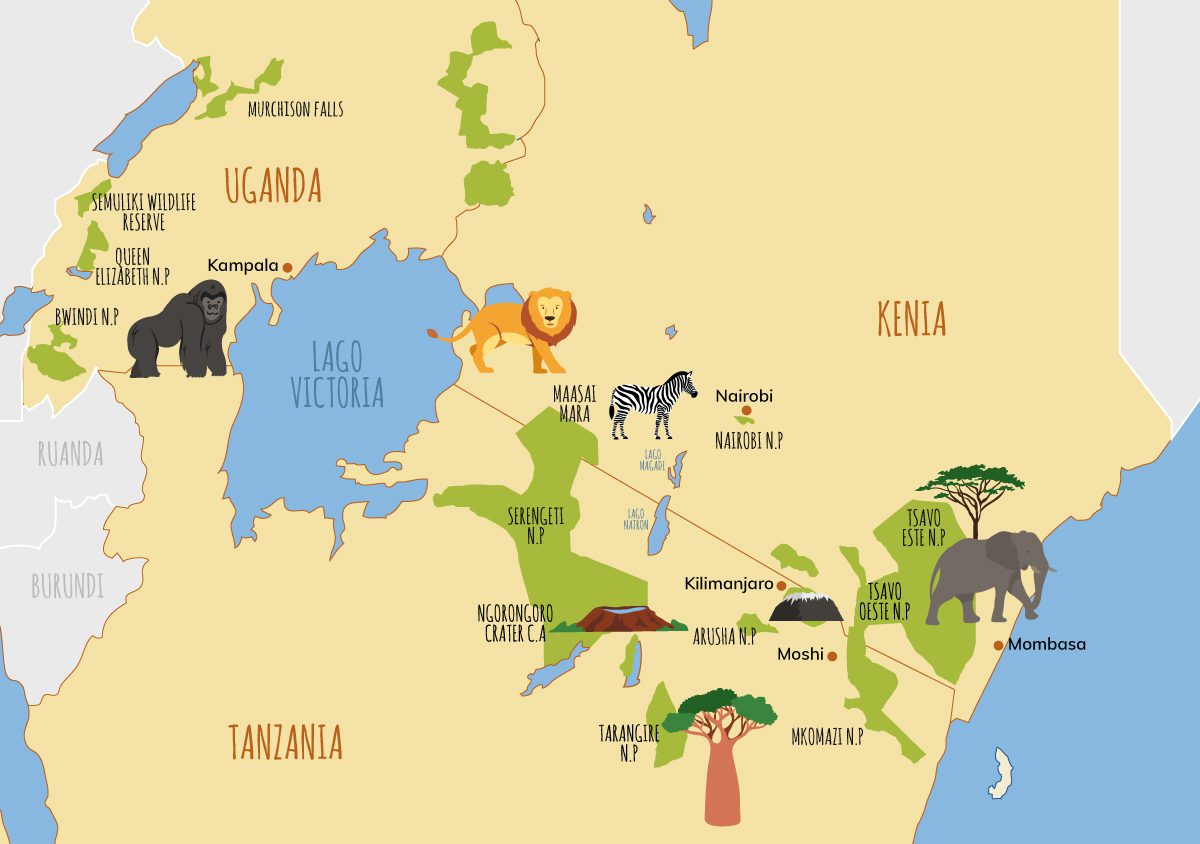
The Kamili safari is our second option for a 15-day trip to Tanzania. This route brings together East Africa’s most interesting reserves in a single safari. We will follow the vast concentrations of herbivores moving between the immense Serengeti plains and the Maasai Mara Reserve. This tour gives us the chance to visit both sides of the border between Kenya and Tanzania to enjoy the wildlife spectacle. The trip ends on the idyllic island of Zanzibar.
At this time of year, the Maasai Mara is home to the great herds of the migration
2. Kenya and Tanzania Safari Kamili
Flight to Nairobi
Arrival in Nairobi. Departure for Lake Naivasha. Safaris
Naivasha to Masai Mara. Afternoon safari
Full day in Masai Mara
Departure for the border. Arrival at Lake Victoria
Excursion on the lake. Departure to the Serengeti. Safari
Full day on safari. Departure for Ndutu (NCA)
Safari in Ngorongoro Crater. Departure for Karatu
Lake Eyasi: Hadzabe and Datoga experience. Return to Karatu
Visit to Mto wa Mbu and cycling in Manyara. Departure for Kilimanjaro.
Flight to Zanzibar. Transfer to the beach
Stay on the beach
Stay on the beach
Airport transfer. Return flight
Arrival in your home city
Departures 25 JUL > 5, 14 AUG > 3 SEP 2019 Price from EUR 3510
Meet at the airport at the agreed time for the flight to Nairobi. Overnight on board.
Day 2 Arrival in Nairobi. Departure for Lake Naivasha. Safaris
We will arrive at the airport in the Kenyan capital very early in the morning. After completing arrival formalities, we will meet our staff, who will take us to the hotel for a shower and breakfast before starting the tour.
Our first destination is Lake Naivasha, one of the many lakes along the Rift Valley. We will arrive by mid-morning, as the journey takes around two hours. There will be time for a boat safari on the lake and a walking safari along its shores. With virtually no big cats, the park allows activities on foot, offering a closer connection with the surroundings than is possible elsewhere.
Day 3 Naivasha to Masai Mara. Afternoon safari
We leave Naivasha early in the morning and head south to the first major highlight of the route: the Maasai Mara reserve, undoubtedly one of the continent’s most visited parks. We will arrive in time for an afternoon safari before sunset.
Day 4 Full day in Masai Mara
We spend the day exploring the park from our camp in search of animals. The Mara is rich in biodiversity and, though challenging, it is possible to spot the Big Five (lion, leopard, elephant, buffalo and rhinoceros).
We will also try to find the great migratory herds of herbivores moving in search of grazing.
We'll finish the day again at our camp.
Day 5 Departure for the border. Arrival at Lake Victoria
We leave the Maasai Mara behind and head west to Isebania, on the Tanzania–Kenya border. Here we change vehicles and staff before entering Tanzania. We end the journey at Speke Bay, on the shores of vast Lake Victoria, a freshwater sea around which the lives of many people in its basin revolve. We will reach our lakeside accommodation in the early afternoon, with time to settle in and take a walk to watch the sun set over the water.
Day 6 Boat trip on the lake. Departure for the Serengeti. Safari
Early in the morning we will board a boat to explore part of the bay, seeing the landscape from another perspective and watching local fishermen at work.
Later, we will set off for Serengeti National Park. Our safari begins as soon as we enter the park. Our camp is in the heart of the Serengeti, in the Seronera area.
Day 7 Full day on safari. Departure for Ndutu (NCA)
We will dedicate this day to a full game drive. Alongside the wildlife, we can enjoy the Serengeti’s vast plains, where it is possible to appreciate the horizon dipping with the curvature of the Earth. Herbivores, big cats, birds and reptiles are spread across the park, and our aim is to come home with as many sightings as possible. Given the park’s size, we will rely on our guide’s skill and radio communications.
Late in the day we head to the Ndutu area, on the boundary between the Serengeti and the Ngorongoro Conservation Area, where we spend the night. This brings us closer to our next destination: Ngorongoro Crater.
Day 8 Safari in Ngorongoro Crater. Departure for Karatu
Early in the morning we will be among the first to descend into the Ngorongoro caldera (Ngorongoro is one of the many volcanoes, some active, in the conservation area that bears its name).
A game drive in Ngorongoro is one of the highlights of any East African safari. A relatively small area, less than 20 km in diameter, is home to resident populations of numerous species, earning it comparisons to Noah’s Ark. It is one of the few places in Tanzania where you can see rhinoceroses. Colonies of flamingos are often seen on the shores of Lake Magadi.
After the crater safari, we take the track uphill to Karatu and settle into our accommodation for two nights.
Day 9 Lake Eyasi: Hadzabe and Datoga experience. Return to Karatu
Our route takes on a different character today as we travel to the nearby Mangola Valley / Lake Eyasi. We aim to find a Hadzabé clan, a semi-nomadic ethnic group related to the San of the Kalahari, living in conditions not very different from those of the Neolithic period. We will try to accompany these hunter-gatherers on a hunt and observe their way of life in this harsh environment.
Nearby, we can visit a Datoga village. The Datoga are related to the Maasai but have adopted a settled way of life, based mainly on agriculture.
After the day we will return to our accommodation in the Karatu area.
Day 10 Visit to Mto wa Mbu and cycling in Manyara. Departure for Kilimanjaro.
On our last day, we will spend more time with local people. We head to the nearby town of Mto wa Mbu, the area’s commercial hub, where market stalls line the lively streets. We will explore the town and its market, and can also visit some traditional homes. Local “Mamas” will prepare our lunch today.
We will stretch our legs on a pleasant bike ride along the trails around Lake Manyara before returning to the vehicles and heading to our accommodation near Kilimanjaro Airport, where we will spend our last night.
Day 11 Flight to Zanzibar. Transfer to the beach
Breakfast and transfer to the airport to fly to Zanzibar. Arrival and transfer to the beach accommodation.
Days 12 to 13 Stay on the beach
Full days at the beach. Walks, swimming, island excursions and trips in a traditional dhow are some of the options.
Day 14 Airport transfer. Return flight
Depending on the flight departure time, transfer to the airport to check in and board the return flight.
Day 15 Arrival in your home city
After the connecting flights, arrival in your home city and end of the trip.
It's official. According to a statement issued today by the Tanzanian Government, from 1 June 2019, Tanzania to ban the entry of plastics to the country. Finally!
Plastic, especially single-use plastic, is a problem worldwide. A highly polluting material that often has a life span of a few seconds, and is rapidly destroying our planet.
Many African countries are determined to address this. Tanzania, alongside South Africa, Rwanda, Nigeria, Cameroon, Egypt, Eritrea, Ghana, Kenya, Mauritania and Morocco, is among the first to take steps towards a total ban on manufacturing and using plastic bags. And now Tanzania is the first to take decisive action.
How does this new law affect you trip to Tanzania? Let's take a look.
When does the regulation enter into force?
From 1 June 2019.
What kind of plastics are prohibited?
is The entry of plastic bags into Tanzania is prohibited of all kinds and of all single-use plastics.
Instead, plastic bags with zip closures, as well as packaging of medicinal products, will be allowed.
How will the Tanzanian Government prevent the entry of plastics?
Checks will be carried out at airports and land borders to prevent plastics entering the country, so the government asks travellers to leave them out of their luggage. No penalties are planned for now, but plastics found will be removed by the authorities.
In Tuareg, we think it's a great initiative. If we were just starting with our campaign #StopPlastic to do our bit to tackle plastic waste, we are delighted to know that those with the power to bring about major change share our aims.
On our side, for all of us trips to Tanzania we will give away our metal water bottle, helping us avoid single-use plastic bottles.
The metal water bottle is part of Tuareg Responsable's #StopPlastic campaign, an initiative to help make the world a better place for everyone.
On many occasions we travel to know new things and discover wonderful places, landscapes and sensations. But there's something else, without which travel would make no sense. Something that vividly reflects all the above, the true essence of the place: local population.
Over our many years of experience we have travelled the world, crossing paths with men, women and children from every corner of the globe. Sometimes they greeted us with smiles; at other times with wise, innocent or curious looks. In every case, their faces have remained etched in our memories and those of our travellers, becoming part of us and ensuring we never forget them.
In their honour, we have put together a collection of images of people we have met on our travel. They are the faces of the human diversity.
In a remote corner north of Tanzania rises an amazing mountain called Ol Doinyo Lengai, where the lava fountains harden in the air and then fragment like glass.
In the language Maasai means Mountain of God and is close to the Lake Natron and is part of the volcanic system of Great Rift Valley. The volcano lies in a section of the fault zone known as Sikes Grid. It is one of the most unusual volcanoes, being the only one to erupt natrocarbonatite lava. Unlike other lavas, these are rich in calcium, sodium and carbon dioxide, giving these eruptions some extraordinary properties.
We use necessary cookies to remember your preferences. With your permission, we use Google Analytics to measure visits and display videos, maps and other third-party content that may use cookies. You can accept, reject or choose which cookies to allow.