

Autumn often brings good trekking conditions in Nepal, particularly in October and November after the monsoon. Good visibility is common, although mountain weather can change and cold conditions or snowfall remain possible at altitude. Forests, villages and Himalayan peaks provide an extraordinary setting for walking, with the pace and stages adapted to conditions along the route.
Our upcoming 2026 departures include Annapurna Base Camp and Poon Hill on 31 October, and Everest Base Camp and Kala Patthar on 28 and 31 October. Both trips last 17 days. For a shorter option, Poon Hill and Pikey Peak depart on 10 November, with special 11-day versions on 26 December.

Nepal: trekking among eight-thousanders
A relatively small territory contains eight of the world’s fourteen peaks above 8,000 metres: Everest, Lhotse, Makalu, Cho Oyu, Dhaulagiri, Manaslu, Annapurna and Kanchenjunga. This extraordinary concentration of Himalayan giants makes the country unique, offering spectacular landscapes and the chance to walk surrounded by the world’s most impressive mountains.
Nepal Its territory contains eight of the planet’s fourteen mountains over eight thousand metres high.
Nepal offers far more than its eight-thousand-metre peaks. Buddhist monasteries, Sherpa villages, Hindu temples, hospitality and unspoilt nature enrich every trekking day. Its trails reveal mountain ways of life, crossing forests and suspension bridges over glacial rivers, with unforgettable sunrises against snowy peaks.

Nepal remains a mythical destination for hikers and mountaineers from all over the world.
If you are planning your first trip to Nepal, choosing a route can raise plenty of questions. Annapurna Base Camp and Everest Base Camp both offer walks among great mountains, but differ in altitude, scenery and exposure to elevation. Neither is a simple stroll: both are multi-day itineraries that require preparation and a willingness to walk day after day.
Below we compare two specific routes: Annapurna Base Camp with Poon Hill, and Everest Base Camp with Kala Patthar. You will also find introductory treks and other ideas for exploring Nepal and the Himalayas.

Annapurna or Everest? Which trek is best?
Not all Annapurna routes are the same. The shorter Ghorepani–Ghandruk and Poon Hill trek stays at lower elevations and is an introductory option. The trip compared here enters the Annapurna Sanctuary and reaches base camp at 4,130 m. It is different from the Annapurna Circuit, which crosses Thorong La. The Everest route follows the Khumbu Valley to Kala Patthar at 5,545 m, spending more time at high elevations.
Both treks offer local cultural encounters and spectacular views, but differ in duration and difficulty.

Elevation gain on Himalayan treks
Annapurna Base Camp and Poon Hill
The walk begins at Kande, around 1,770 m, and gains elevation through villages, forests and the Modi Khola Valley before entering the Annapurna Sanctuary. The highest point is base camp at 4,130 m. The progressive stages are part of the itinerary’s design; this remains a demanding mountain route with substantial accumulated ascent and descent.
Everest Base Camp and Kala Patthar
After flying to Lukla, the first walking stage reaches Phakdingma at around 2,650 m, followed by Namche Bazaar at 3,440 m. The itinerary includes an acclimatization day in Dingboche at 4,410 m before continuing to base camp and Kala Patthar at 5,545 m. The greater altitude is a key difference from Annapurna.

Distances, elevations and duration of trekking
Trek to Annapurna Base Camp and the Poon Hill viewpoint
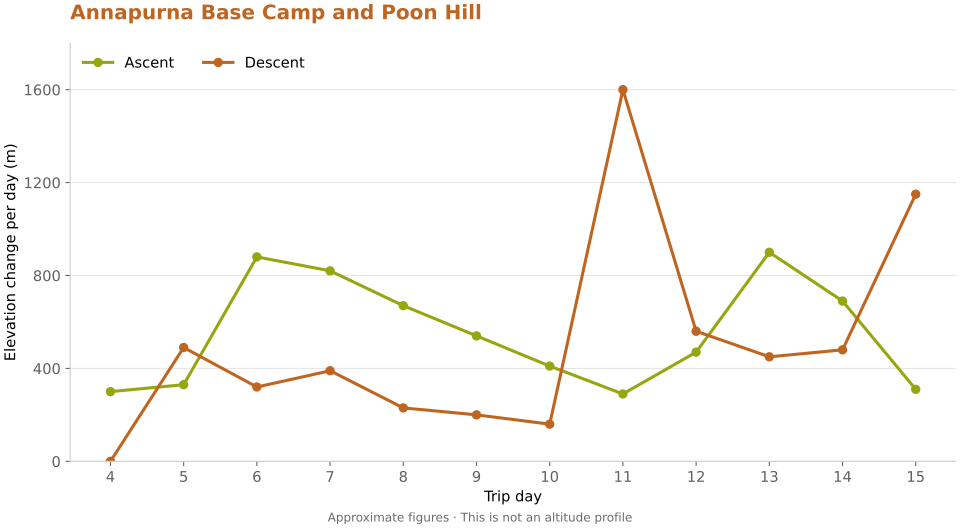
Annapurna Base Camp lies at 4,130 m in the Annapurna Sanctuary, a glacial amphitheatre surrounded by some of the massif’s great peaks. The full trip lasts 17 days and includes Kathmandu and Pokhara. The table summarizes the walking stages in the current itinerary; distances, times and elevation changes are approximate.
| Trip day | Approx. km | Approx. hours | Ascent (m) | Descent (m) |
|---|---|---|---|---|
| 4 | 2 | 1 | 300 | 0 |
| 5 | 12 | 6 | 330 | 490 |
| 6 | 10 | 5 | 880 | 320 |
| 7 | 12 | 6 | 820 | 390 |
| 8 | 8 | 4 | 670 | 230 |
| 9 | 6 | 3 | 540 | 200 |
| 10 | 5 | 2 | 410 | 160 |
| 11 | 15 | 6 | 290 | 1600 |
| 12 | 8 | 4 | 470 | 560 |
| 13 | 11 | 6 | 900 | 450 |
| 14 | 10 | 5 | 690 | 480 |
| 15 | 12 | 4 | 310 | 1150 |
| Approximate total | 111 | 52 | 6610 | 6030 |
Trekking Everest Base Camp and Kala Patthar
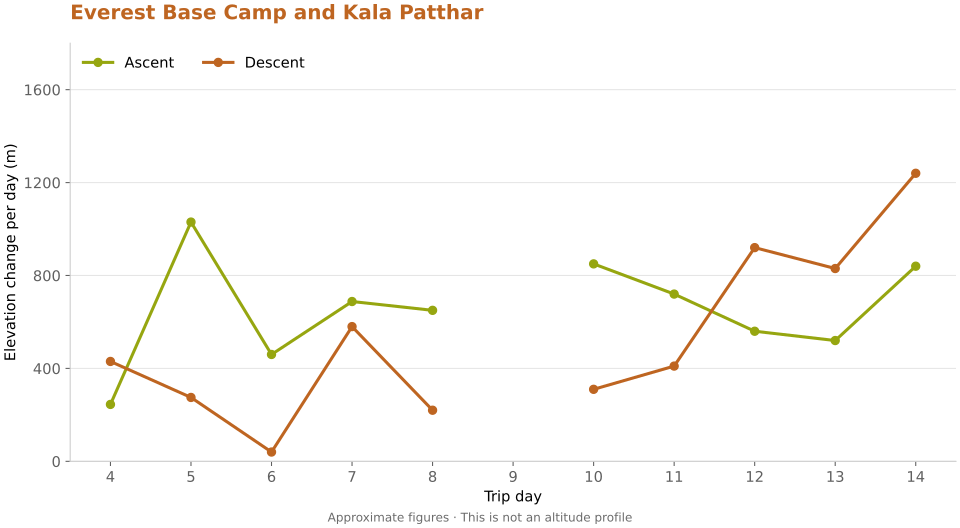
The Everest Base Camp trip follows the Khumbu Valley and its Sherpa villages to base camp and the Kala Patthar viewpoint. The full trip lasts 17 days, including transfers and visits in Kathmandu. The table shows the trekking stages and acclimatization day, with approximate figures.
| Trip day | Approx. km | Approx. hours | Ascent (m) | Descent (m) |
|---|---|---|---|---|
| 4 | 8 | 2 | 245 | 430 |
| 5 | 12 | 5 | 1030 | 275 |
| 6 | 4 | 2 | 460 | 40 |
| 7 | 7.5 | 4 | 688 | 580 |
| 8 | 13 | 6 | 650 | 220 |
| 9 | Acclimatization | |||
| 10 | 14 | 5 | 850 | 310 |
| 11 | 15 | 7 | 720 | 410 |
| 12 | 13 | 6 | 560 | 920 |
| 13 | 14 | 6 | 520 | 830 |
| 14 | 16 | 6 | 840 | 1240 |
| Approximate total | 116.5 | 49 | 6563 | 5255 |
Approximate figures from the current itinerary. Day numbers refer to the full trip; stages may change with the weather and the group’s condition. Annapurna’s final walking day includes Poon Hill and the descent to Ulleri; a separate viewpoint excursion is not added again.
Altitude and the progression of stages matter as much as distance and elevation gain.

Khumbu (Nepal) | Photo © Eva Respalzuri
Trekking through the Himalayas and mythical mountains
Annapurna Base Camp and Poon Hill
The route combines valleys, forests and villages with entry into the Annapurna Sanctuary, where the mountains form a great amphitheatre. Poon Hill adds a panorama of the Annapurna massif and Dhaulagiri when visibility allows.
Everest Base Camp
The Khumbu Valley brings together some of the Himalayas’ best-known names: Ama Dablam, Lhotse, Nuptse and Everest. Monasteries and Sherpa villages accompany the ascent; base camp and Kala Patthar are highlights of the route, subject to mountain conditions.

Environment through which the main routes in the Himalayas run
Annapurna Base Camp
From Kande and the surrounding villages, the route crosses cultivated fields, forests and communities with Gurung traditions before entering increasingly alpine terrain. This transition from rural valley life to the Sanctuary is one of its main attractions.
Everest Base Camp
After reaching Lukla, the trail passes through forests and villages in the Khumbu Valley, with a strong Sherpa cultural presence. As the route climbs towards Dingboche, Lobuche and Gorakshep, the landscape becomes more mineral, with moraines, glaciers and less vegetation.
You can find more information about trips to Tibet and Nepal on our website. And do not hesitate to contact us if you have any questions!

Annapurnas vs. Everest
In conclusion, we can see that each option has its strengths or possible disadvantages. You will have to consider each option in your trek through the Himalayas to choose the best route on the “roof of the world”.
Annapurnas
A progressive route combining Annapurna’s villages and forests with the Sanctuary at 4,130 m and the views from Poon Hill. The 2026 departure shown below lasts 17 days.

 Nepal
✔️ Departure 31/10/2026
✔️ From €2090 + approx. €530 air taxes

Everest
Nepal contains eight of the fourteen mountains over eight thousand metres high. We are undoubtedly facing what is known as the roof of the world.

✔️ Departures 28/10/2026 | 31/10/2026
✔️ From €2380 + approx. €530 air taxes

Other journeys in Tibet
The Tibetan Plateau, at an average altitude of 4,500 m, is framed by the world’s highest mountains. Isolated for centuries, its interior is an endless steppe crossed by rivers and turquoise lakes.


Trekking for beginners
An option for getting started with multi-day trekking in Nepal, with walks around Ghorepani and Poon Hill, plus visits to Pokhara and Kathmandu. The route stays lower than the base camps, but still requires preparation for the walking days and elevation changes.

✔️ Departure 10/11/2026
✔️ From €1930 + approx. €530 air taxes

✔️ Departure 26/12/2026
✔️ From €1980 + approx. €550 air taxes
Ascent of Pikey Peak – Deep into Nepal
Pikey Peak follows villages, monasteries and trails in the eastern Himalayas to a 4,065 m summit. It offers an alternative to the base camp routes, with views towards Everest when the weather allows. In 2026, there is a departure on 10 November and a special Christmas version on 26 December.

✔️ Departure 10/11/2026
✔️ From €1750 + approx. €530 air taxes

Also at Christmas: 26/12/2026, 11 days. This version has its own itinerary and fare: from €1690 + approx. €540 air taxes.
Other trips to the Himalayas
We enter Bhutan, known to its people as Drukyul. Through deep valleys and steep mountains, we discover its culture and architecture.

✔️ Departures 31/10/2026 | 03/11/2026 | 14/11/2026 | 28/11/2026 | 05/12/2026 | 26/12/2026
✔️ From €2,790 · international flights not included
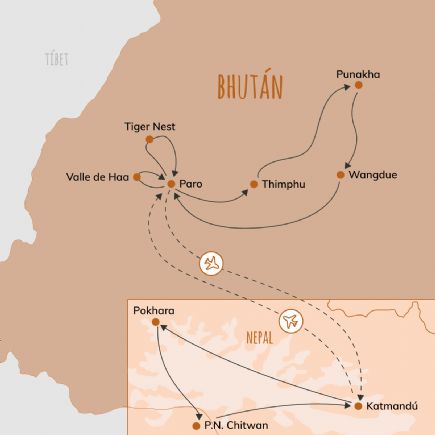
Dates refer to arrival in Kathmandu. The amount comprises the €2,690 base fare plus a €100 high-season supplement; the Bhutan visa (€40) is paid separately.