

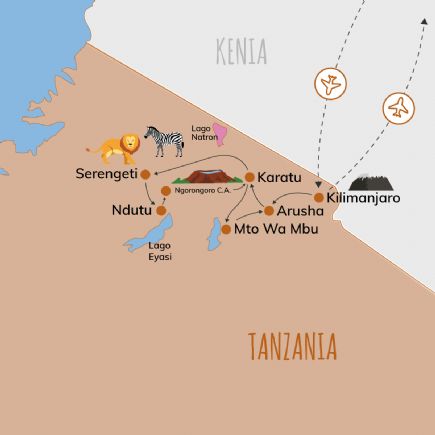
An exciting spectacle known as the Great Migration: between mid-February and early March, herds of wildebeest and zebras move between the Serengeti and Ndutu. During this period, the herds gather around Ndutu, in the southern Serengeti and north of Ngorongoro in Tanzania.
At this time, wildebeest calves are born, and predators abound, drawn by the plentiful potential food.

River crossings are another great scene in the migration: wildebeest and zebras face steep banks, currents and crocodiles. In February, attention turns to the southern plains and the birth of the young.
Travelling to Tanzania at this time offers a chance to witness a period of extraordinary activity and an astonishing burst of life. Sharing it with an expert Spanish-speaking guide brings an experience beyond conventional tourism.
The exact location of large herbivore herds cannot be known in advance. We may therefore need to travel some distance from our accommodation to reach them.

During the trip to Tanzania Accompanying the Great Migration, we use permanent camps integrated into the landscape and built from local materials. Most staff are local, supporting employment. Lunch and dinner are served where we stay, except during safaris.
About the Great Migration
What is it?
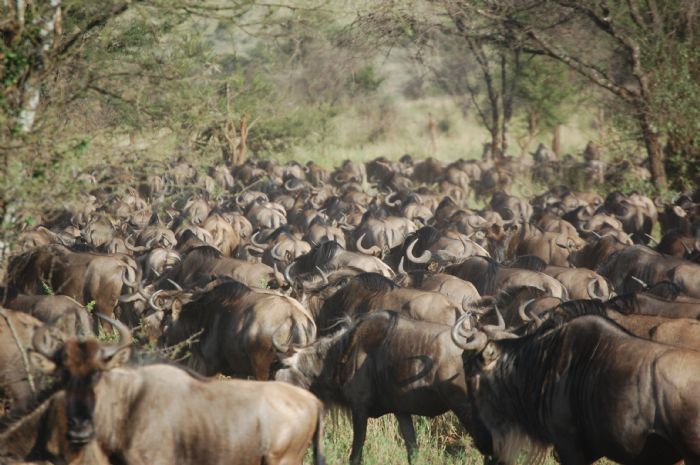
One of the natural world's most spectacular events. Around 750,000 zebras and 1 million wildebeest move in search of fresh pasture brought by the rains. Large carnivores follow this vast moving source of food.
Where does it take place?
The Great Migration follows an annual cycle. Herds move through the Serengeti and Masai Mara ecosystem, between Tanzania and Kenya, searching for pasture and water before returning to the southern plains. Exact timing depends on the onset of the rains and other factors.

What animals can we see?
Wildebeest, Thomson’s gazelles and zebras gather in herbivore herds, finding safety in numbers. Predators accompany them: although territorial rather than migratory, they follow food. The Great Migration It draws predators such as lions, leopards, cheetahs and hyenas, following prey herds in search of hunting opportunities. Migratory birds also follow the herbivores in search of food.
¿Where are we staying?
During the trip through Tanzania we will stay in tented camps and lodges in natural surroundings, combining comfort, character and excellent locations. In the Serengeti and Ndutu we will stay in Safari-type camps managed by local staff.
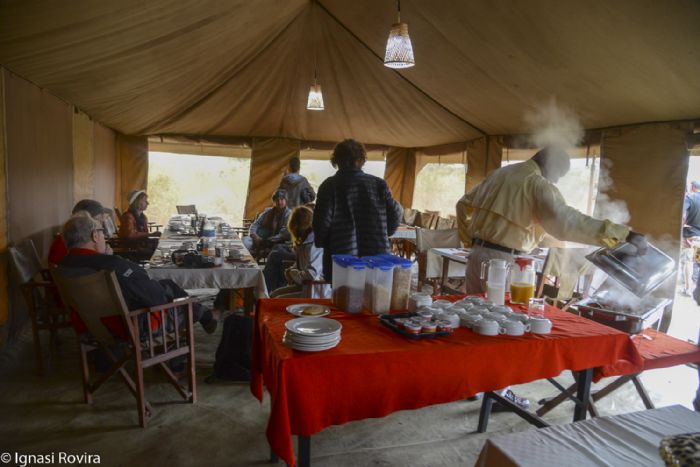
The tents are equipped with single beds, bed linen, shower and private toilet. There is also a shared dining tent. In Karatu, we will stay in a lodge, ideal to rest after the days of safari.
¿How do we get around?
We will travel in 4×4 vehicles specially adapted for safaris, offering comfort and safety. Each traveller has a window seat for wildlife viewing. Pop-up roofs also allow passengers to stand up to watch the animals.

Highlights of the Great Migration
- 4×4 vehicles with pop-up roofs, adapted for safaris.
- We will stay in a combination of Tented camps and hotels. Comfort and contact with nature.
- The aim is to observe concentrated herbivores and predators, rather than tour Tanzania.
- We reduce distances to spend more time with wildlife.
- Travelling with a safari specialist who knows the area well adds value to an already spectacular journey.
The Great Migration, the journey
 Tanzania
✔️ 13 Feb 2027
✔️ From 3.990 € + approx. air taxes 578 €

Trekking to Kilimanjaro
Beyond a safari in the Ndutu plains and Serengeti, another way to discover Tanzania is the trekking to Kilimanjaro, an expedition for those seeking the physical challenge of reaching Africa’s highest summit: the Uhuru Peak5,895 metres.
✔️ Daily departures
✔️ From 1.980 € · flights not included

Other safaris in Tanzania
✔️ Start of the tour in Arusha: 11 Nov 2026
✔️ From 3.045 € + approx. air taxes 575 €
REMEMBER TANZANIA’S BAN ON BRINGING PLASTIC BAGS INTO THE COUNTRY – #StopPlastic
Looking for inspiration for your next trip?
February offers an ideal opportunity to explore unique places and enjoy unforgettable experiences. We have prepared a selection of destinations that combine culture, landscapes and wildlife.