

The St Lawrence River forms the backbone of this trip to Canada, following the route of explorer Jacques Cartier (31 December 1491 – 1 September 1557). Some of the Americas’ oldest cities, nature parks with exceptional scenery and wildlife watching make up this varied Quebec itinerary.
Jacques Cartier was the first European to explore and navigate the St Lawrence River.

In the footsteps of Jacques Cartier
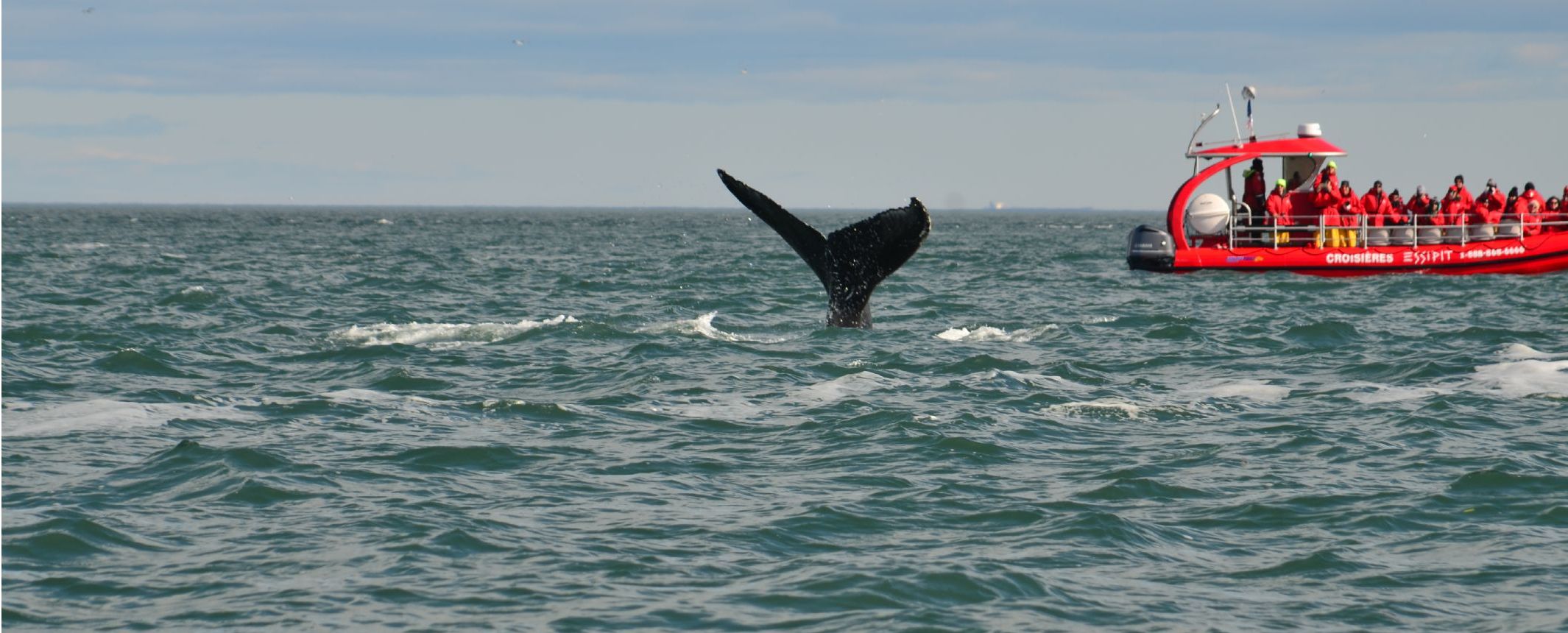
The river is the thread linking this August trip to Canada. Two beautiful cities, Montreal and Quebec, were built along its banks. This region has exceptionally rich ecosystems: alpine forest, tundra and taiga, with whales, moose, black bears, caribou and seals…
We make the most of Quebec’s wonderful network of park trails, combining walks with train journeys, canoeing on lakes and sea kayaking to discover all this remarkable region has to offer.
 Canada
✔️ Departure 19 JUL | 2, 16 Aug | 5 Sep 2026
✔️ Price from 3840€


Trip highlights
- St Lawrence River
One of the world’s largest estuaries, the backbone of Québec and the thread running through our route. Jacques Cartier sailed it in the 16th century in search of the Northwest Passage to the Indies. - Quebec wildlife
The whales in the river are undoubtedly the highlight of the route, alongside black bears, herds of caribou and the enormous moose, a symbol of the local wildlife. - Québec National Parks
Tundra vegetation, pristine rivers and the Appalachian foothills. Activities in the parks will allow us to enjoy this remarkable environment.
Itinerary of the trip to Canada
| Route | Meals | Accom. |
| Flight to Montreal | Hotel | |
| Montreal – Grands Jardins National Park – Baie St. Paul | D | Hotel |
| Grands Jardins National Park | D | Hotel |
| Baie St. Paul - Charlevoix train – Saguenay – Les Escoumins | D | Local hotel |
| Whale-watching excursion – Tadoussac – Baie Ste. Marguerite | D | Local hotel |
| Les Escoumins – ferry to Trois-Pistoles – Gaspésie National Park | D | Hotel |
| Gaspésie National Park | D | Hotel |
| Gaspésie National Park – Rimouski | D | Hotel |
| Bic National Park | D | Hotel |
| Rimouski – Québec | D | Hotel |
| Jacques Cartier National Park | D | Hotel |
| Québec | D | Hotel |
| Québec – Montréal | D | Hotel |
| Montréal. Flight back | D | On board |
| Arrival in your home city | ||
| D – Breakfast | A – Lunch | C – Dinner | ||
Walks and other activities
The walks on this itinerary are of easy to moderate difficulty, suitable for any traveller accustomed to walking.
Daily walks of between 2 and 5 hours are planned. Some trails are more demanding, with climbs of up to 500 metres. All the parks have trails for different ability levels, and the guide will recommend the most interesting based on their judgement and the group’s abilities. Most walks follow forest trails and rivers, reaching modest summits always below 2,000 metres. The recommended minimum age for this route is 14.

Both canoeing on the lake and sea kayaking in Bic National Park are easy activities suitable for beginners, with no previous experience required. Sea kayaking is timed around the tides so there is no need to paddle against the current.
In one of the parks (Saguenay, BIC, Jacques Cartier...), mountain bikes may be available to rent for exploring suitable trails. If you are interested, ask the guide locally.
The park websites listed in the itinerary offer downloadable guides in English and/or French, with details of the walks and other useful information.
Difficulty / Conditions of travel
The group is led by ONE person, who acts as driver and coordinator and is responsible for driving, cooking and logistics. All travellers are expected to help with daily tasks such as preparing picnics and loading and unloading the vehicle and luggage. Teamwork is essential to make the most of the trip. The faster these tasks are done, the more time we have for activities and enjoying the route’s exceptional surroundings.
The guide is not a specialist in fauna, flora or local history, but will always try to answer our questions in the best possible way.
For safety reasons, the guide cannot give commentary while driving. The guide accompanies some walks; in all cases, the trails are well signposted.
Documentation required to travel to Canada
- Spanish citizens need a valid passport to travel to Canada.
- It is mandatory to obtain an Electronic Travel Authorization (eTA) before travelling by air.
- The eTA is requested on the official Canadian government website and costs $7 Canadian dollars.
- Although they are not always requested, it is advisable to carry documentation that supports the purpose of the visit and the intention to return.
- It is advised to have travel insurance with medical coverage.
- It is important to check the latest information on the official Canadian government website before travelling.
- It is recommended to have a passport valid for at least 6 months, although Canadian law only requires that the passport be valid during the stay.
Travel health and vaccines
Compulsory vaccinations and health recommendations: no special health precautions are recommended beyond common sense for routes largely taking place in natural surroundings.
The Government of Catalonia provides travellers with the Sanitat Respon telephone service, 902 111 444, and the website “Consells i vacunacions a viatgers internacionals” for information about vaccination centres.

Recommended clothing and equipment for this trip
Luggage must be packed in a soft bag with a maximum capacity of 80 litres. We recommend carrying a few essentials in your cabin bag in case your checked luggage is delayed.
- A cap or hat.
- Hiking socks and trousers; lightweight hiking boots with good ankle support (we recommend telescopic walking poles).
- Waterproof, breathable jacket. A fleece for changeable weather.
- Short- and long-sleeved shirts, preferably light-coloured.
- Shorts and swimwear.
- Bath towel.
- Comfortable clothes for evenings in towns or at camp (trousers, shirts, a light jumper and comfortable shoes).
- A 25–35-litre daypack for jackets, drinks, snacks, sunglasses, a camera and so on. The guide will tell us each day what we need to bring.
- Water bottle: allow at least two litres per person.
- A sleeping bag with a comfort rating of around 10° for nights in the parks’ permanent tents.
- Head torch and spare batteries.
- Toiletries, insect repellent, high-SPF sunscreen and a basic first-aid kit.
- Adapters for plugs, power bank, memory cards and additional batteries for cameras.
- Small travel binoculars can be useful for wildlife observation.
